


AI Agents
Agents that finish the task, not just answer
We build agents that take a goal, use your own systems and documents to work through it, and hand back to a person at the point where a human should decide.
Talk to us about your projectWhat an agent does that a chatbot cannot
A chatbot retrieves an answer and hands you back to a form. An agent plans a sequence, calls the API that issues the refund or updates the CRM record, checks the result, and takes a different route when the first one fails. The difference is whether the work is finished when the conversation ends.
That capability is also the risk, so the unglamorous parts come first: which tools the agent may call, and which actions stop for a human signature before they run. Without those limits you have not shipped a product. You have given a language model your production credentials.
Capabilities
What we build agents to do
Each agent is built for one job. A support agent and a research agent share almost nothing beyond the model, and building a single general agent for both is how a project ends up doing neither well.
Support agents
Handles a customer thread across chat and email, issuing the refund or the reschedule through your own API. What it cannot close arrives with the history attached.
Internal knowledge agents
Retrieval over your Notion, Confluence, SharePoint or ticket history, answering with a citation to the source document so the answer can be checked.
Research agents
Multi-step research on a market or a named prospect, returned as a structured report with its sources, not a chat log you have to read backwards.
Sales qualification and outreach
Enriches an inbound lead, drafts follow-up based on what that account actually did, then writes the outcome back to HubSpot or Salesforce.
Tool and API integration
The agent calls your internal endpoints and writes to the system of record, against an allowlist naming exactly which routes it is permitted to touch.
Multi-agent orchestration
A planner delegating to a researcher and a writer, used when one agent genuinely cannot hold the task. Usually it can, and we will say so.
Guardrails and policy
Spend and time caps on every run, PII redaction before anything leaves your network, and validation that blocks a malformed action rather than executing it.
Observability and tracing
Every step, tool call and token is logged, so when a customer disputes what the agent told them you can read back the actual run.
Human handoff
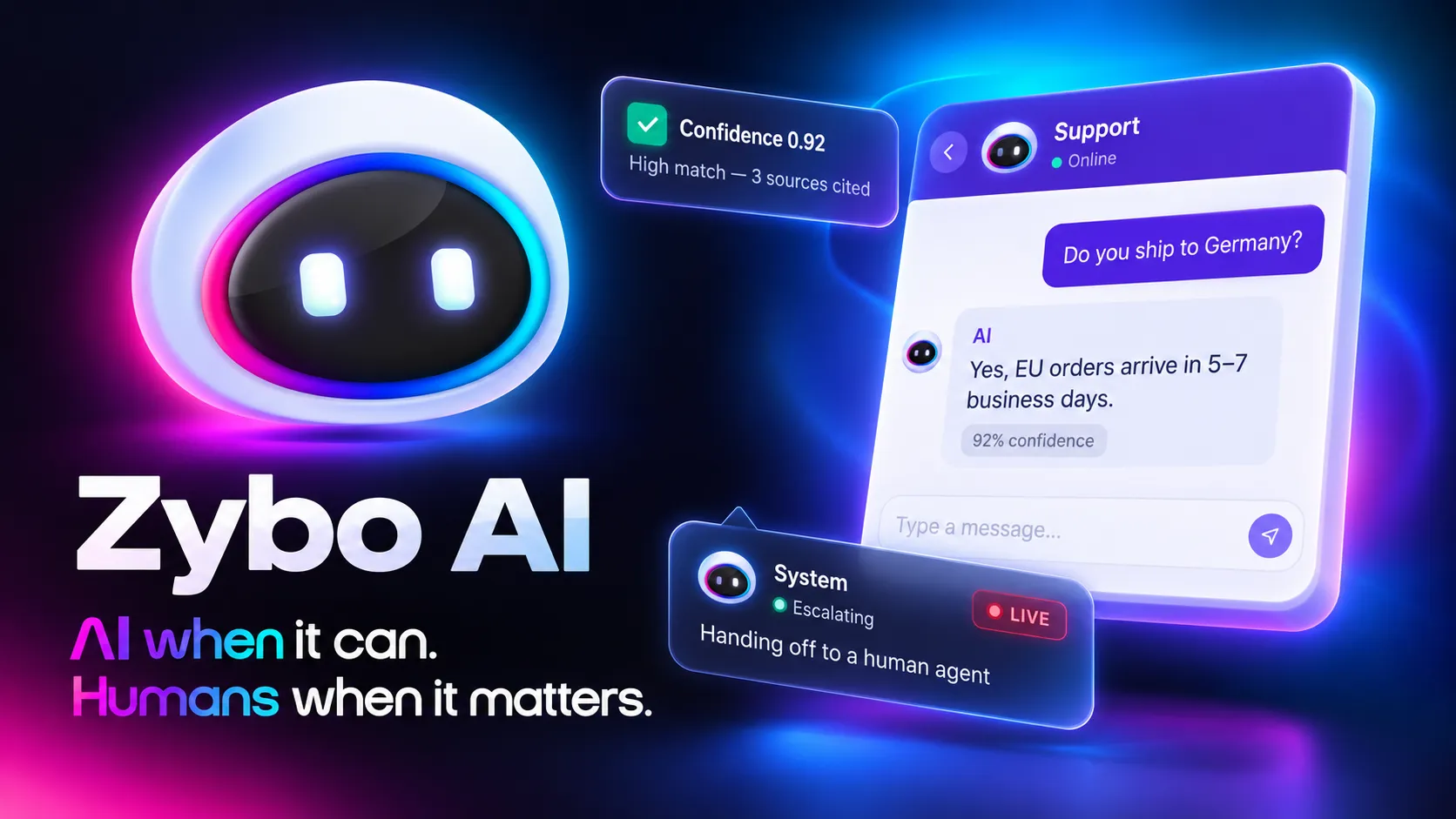
Confidence thresholds and approval checkpoints, so a refund above your limit waits for a person instead of the agent deciding it is probably fine.
What you get
What you own at the end
Every engagement ends with things you can hand to another team, including the parts that make the agent auditable.
- RUNNING AGENT
- The agent, live in production
- Deployed to your infrastructure or ours, with source, prompts, tool definitions and the deploy pipeline handed over. You can change what it does without booking time with us.
- GUARDRAIL CONFIG
- Permissions, caps and escalation rules
- The written list of tools the agent may call, the spend ceiling per run, and the actions that stop for human approval. This is the document your risk review will ask for.
- EVALUATION SET
- Test cases and a quality baseline
- Real tasks and conversations scored before launch, so a future model upgrade can be measured rather than guessed at. Model providers change behaviour without warning, and this is how you notice.
- OPERATING NOTES
- Architecture and running costs
- How it is wired, what a typical month of token spend looks like at your volume, and the first things that will break as conversation volume grows.
How we work
From one use case to a live agent
Timelines below are typical for a first agent. If the scope does not survive the pilot, we would rather say so in week three than in month four.
Scoping
1 weekWe pick one job the agent should own end to end, then work out which systems it needs to touch and what it must never do alone.
Pilot
2–3 weeksA working agent on your real data, run against real cases. This is the step that sometimes ends a project, and it is a cheap place to find that out.
Build and harden
4–8 weeksIntegrations, guardrails, tracing and the escalation path, plus the evaluation set we measure against before it is allowed to speak to a customer.
Run and tune
OngoingReading real transcripts, tightening prompts and permissions, and cutting token cost once you can see where the agent actually spends its time.
Is this the right service for you?
Worth reading before you get in touch — it saves both of us a call.
A good fit if…
- There is a repeatable task a person currently does end to end
- The agent needs to act in your systems, not only answer questions
- You have documents, tickets or transcripts it can be grounded in
- You can name who signs off when the agent is unsure
Probably not, if…
- You need fixed rules on a fixed workflow — AI Automation fits better
- The intelligence belongs inside your product itself — see AI-Integrated Software
- There is no written knowledge yet to ground the answers in
- You want the agent acting with no human able to override it
Frequently Asked
Questions
Common questions about designing, launching, and governing AI agents.
A chatbot answers questions. An AI agent takes actions. Agents use language models to reason through a task, call tools and APIs, read and write data, and loop through steps until the job is done — all with minimal human supervision. Think of an agent as a digital teammate, not a help article.
Typical use cases: customer support that can resolve issues end-to-end (not just answer questions), sales agents that research prospects and draft outreach, internal knowledge agents that answer questions from your docs and ticket history, and research agents that gather, compare, and summarize information from the web and internal sources.
Most production agents run on OpenAI (GPT-4, GPT-4 Turbo) or Anthropic (Claude) because they're reliable at tool use and reasoning. For privacy-heavy workloads we run open-source models (Llama, Mistral) on your infrastructure. We choose per use case — not a default stack.
Agents run inside guardrails: allowlists of tools/APIs they can call, hard caps on spend and time, validation on every output, human-in-the-loop checkpoints for risky actions, and full observability so you can audit every step the agent took and why.
Yes. We build RAG (retrieval-augmented generation) pipelines that index your documents, tickets, wikis, and databases, then give the agent semantic search over that knowledge. The agent only reads the sources you grant it, with full access logging.
A focused single-purpose agent (e.g. support triage, sales research) typically starts at ₹3L–₹8L (roughly \$3.5k–\$10k) for build and deployment, plus ongoing LLM API costs. Complex multi-agent systems with custom tools run much higher. See our AI chatbot cost guide for detailed tiers.
Have a project in mind?
Fixed price after a paid discovery — no hourly billing. A real engineer reads every enquiry, and we reply within 24 hours.