



Integrations & APIs
The gaps between your tools, closed
We connect the systems you already run and build the endpoint layer other systems call into, with the retries, logging and reconciliation that decide whether an integration survives its first bad week.
Talk to us about your projectWhy integrations break
Nothing about connecting two APIs is hard on the happy path. The work is everything after: the partner times out halfway through a write, a record arrives with a field somebody renamed, the same webhook is delivered more than once. An integration with no answer to that is a demo.
So the unglamorous parts get built first. Idempotent handlers, retries with backoff, a dead-letter queue you can open and replay, and a scheduled job that compares both systems and reports what disagrees. You find out in minutes instead of at quarter end.
Capabilities
What we connect and what we build
Some of this is glue between systems you do not own. Some of it is the endpoint layer other systems call into. Most engagements turn out to be both.
CRM and marketing sync
Two-way sync with Salesforce, HubSpot, Zoho or Pipedrive, including field mapping, deduplication, and an agreed rule for which side wins a conflict.
ERP and finance connectors
SAP, NetSuite, Dynamics, QuickBooks, Xero and Odoo: invoice sync, journal posting, and a reconciliation view finance can read without asking an engineer.
Payment and billing plumbing
Checkout, subscriptions, refunds and dunning wired through to your accounting system. Deeper gateway work belongs to our Custom Payment Gateway Integration service.
Messaging channels
Slack, Teams, WhatsApp Business, Telegram, SMS and email, wired both ways, so an alert can be answered rather than only read.
Custom REST and GraphQL APIs
Versioned endpoints documented in OpenAPI or a GraphQL schema, secured with OAuth 2.0 or API keys, and rate-limited per client.
Webhook and event infrastructure
Signed payloads, idempotent handlers, retry with exponential backoff, and a dead-letter queue, so a partner outage does not quietly lose orders.
Legacy system adapters
A queue-based layer in front of the brittle system doing format translation, throttling and error normalisation, so your modern app never meets its edge cases.
AI-ready endpoints
Structured responses, scoped auth, honest error codes and action names an agent can read, so an LLM calling your API picks the right one.
API as a product
Developer portal, self-serve key management, usage metering and the billing hook, for when API access is the thing you are selling.
What you get
What you actually own afterwards
The things that exist at the end of the work, rather than a list of what happened during it.
- Working integration
- The connection, live in production
- Running in your environment, with the source, the credential handling and the deploy pipeline handed across. Nobody has to call us to change a field mapping or add a route.
- The contract
- OpenAPI or GraphQL schema
- Generated from the code rather than written alongside it and left to rot, plus a Postman collection, so a partner developer can make a successful first call without a meeting.
- Failure handling
- Retries, dead-letter queue, alerts
- The queue is inspectable and replayable, and a named person on your side is told when the same call keeps failing. Integrations fail; not knowing about it is the real problem.
- Sync health
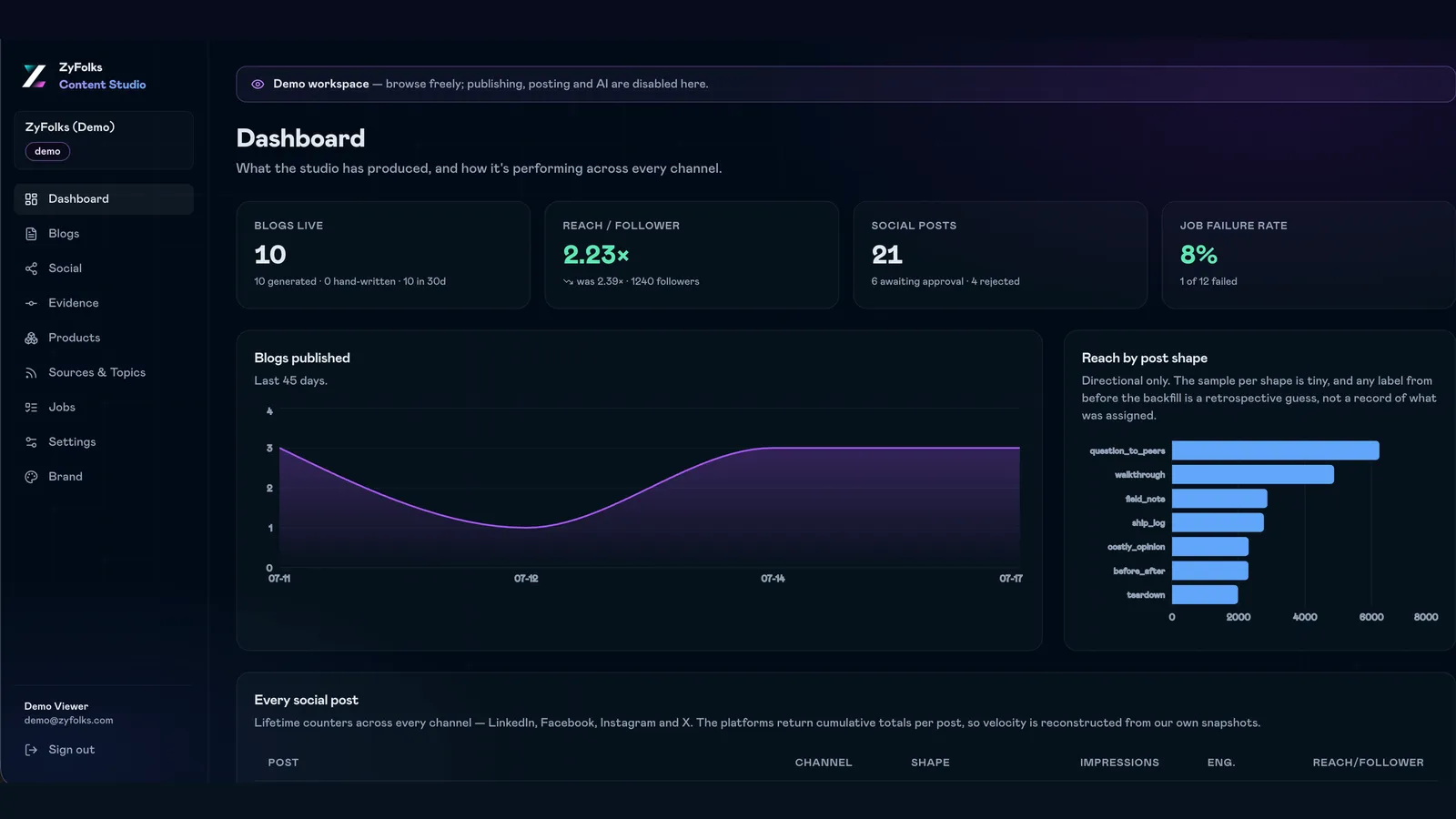
- A reconciliation dashboard
- A scheduled comparison of both systems that reports what disagrees, with its run history kept. This is how you find the record that quietly stopped syncing weeks ago.
How we work
From first call to something running
The ranges below are typical for a first release. Discovery is paid, and it produces the scope and the quote rather than following them.
Discovery
1–2 weeksWe read the real API docs, test the auth and the rate limits ourselves, and find the fields on either side that do not map cleanly.
First connection
1–3 weeksOne system, one direction, running against real data. If the vendor API cannot do what their sales page implied, this is where we say so and rescope.
Build
4–10 weeksThe remaining systems, the custom endpoints, the retry and reconciliation layer, and the monitoring, shipped in increments you review as they land.
Run and watch
OngoingAlert tuning, quiet-failure hunting, and the repair work needed when a vendor deprecates an API version, which they will do without asking you first.
Is this the right fit?
Worth two minutes before you write to us. It saves a call that goes nowhere.
A good fit if…
- You run several systems that do not share data, and people retype between them
- You need to expose your product's capability to partners or an agent layer
- An existing integration fails quietly and nobody trusts the numbers any more
- You are selling API access and need versioning, keys and usage metering
Probably not, if…
- You need the whole product built, not the joins — see Web & SaaS Platform Development
- Only card checkout and subscriptions — Custom Payment Gateway Integration is the narrower, cheaper fit
- A single two-app trigger that Zapier or Make already handles for a monthly fee
- The system you want connected has no API, no webhook and no database access
Frequently Asked
Questions
Common questions about integrations and custom APIs.
Payment gateways (Stripe, Razorpay, Paddle, PayPal), CRM sync (Salesforce, HubSpot, Zoho), ERP connectors (SAP, NetSuite, Odoo), messaging (Slack, Teams, WhatsApp, Telegram), analytics (Segment, Mixpanel, GA4), and custom webhook pipelines between any two systems with APIs. If it has an endpoint or a webhook, we can glue it in.
Yes. REST and GraphQL APIs, versioned, documented with OpenAPI / GraphQL schemas, rate-limited, secured with OAuth 2.0 or API keys, and published via an internal or public developer portal. If you're selling API access as a product, we'll also build the self-serve key management and usage-based billing layer.
Yes, with a warning label: legacy integrations usually need a middleware layer (queue-based, retry-safe, with audit logs) because direct calls to brittle legacy systems break under load. We build adapters that isolate the legacy edge cases so your modern apps stay clean.
Idempotent retries, dead-letter queues, alerting on repeated failures, reconciliation jobs that detect drift between systems, and dashboards showing sync health. Integrations fail — the question is whether you know about it in minutes or in months.
Both. Plain glue code when the rules are deterministic. AI-assisted routing when the inputs are unstructured (inbound emails, free-text tickets, scanned documents). We often mix: AI classifies / extracts, traditional automation executes the downstream action.
One system, one direction, a clean API and no edge cases: ₹1.5L–₹2L. Two systems held in agreement, with error handling and production monitoring: ₹5L–₹8L. An integration layer across several systems plus an API of your own: ₹14L–₹24L. A self-serve API run as a product, under audit, starts around ₹40L. Discovery is paid and always precedes a fixed-price quote — see our API integration cost guide for the full tier breakdown.
Have a project in mind?
Fixed price after a paid discovery — no hourly billing. A real engineer reads every enquiry, and we reply within 24 hours.