


What breaks when you let AI answer questions about money
The scary version of an AI blockchain tool is one that answers confidently and wrongly — tells you a wallet sent funds it never sent. When the subject is…

The scary version of an AI blockchain tool is one that answers confidently and wrongly — tells you a wallet sent funds it never sent. When the subject is money, a made-up answer is worse than no answer. The version worth trusting never invents; every reply is pulled straight from what the chain actually recorded.
Confident and wrong is the real failure mode
Plenty of AI tools will happily generate a plausible-sounding answer whether or not it’s true. That’s tolerable when you’re brainstorming a caption. It’s dangerous when someone is deciding whether to flag a wallet, block an onboarding or escalate a fraud case on the strength of what the tool said. The failure isn’t the AI being unable to answer — it’s the AI answering when it shouldn’t, and nobody being able to tell the difference.
The part that makes it safe to trust (the short technical bit)
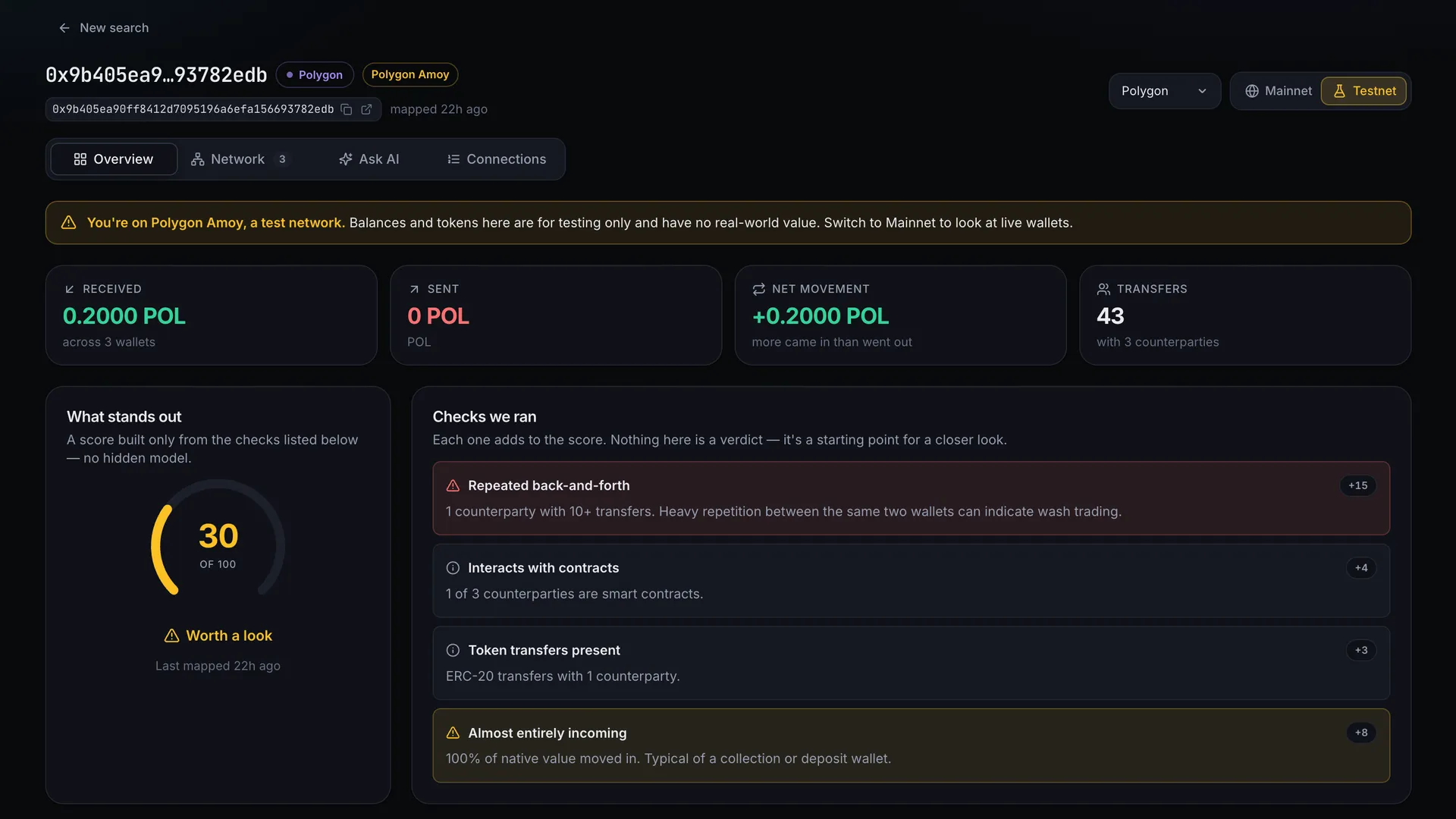
We designed the explorer so the AI’s job is narrow: understand your plain-English question and turn it into a precise query. It does not make up the answer. The transactions, the addresses and the relationships all come back from live on-chain data. The language model is the translator, not the source of truth. So “show the last 5 transactions” returns the five the chain recorded — not five the model thought sounded right.
Why this matters more than it sounds
On a blockchain, the ledger is ground truth — it can’t be argued with. The whole reason to investigate on-chain is that the record is definitive. A tool that blurs that certainty with AI guesswork throws away the one advantage the data had in the first place. Keeping the model on translation duty, and the answers on the ledger, is what keeps the tool honest — and keeps you from acting on something that was never real.
FAQ
Can the AI hallucinate a transaction that didn’t happen? The design keeps the model out of the answer. It interprets your question; the data comes from the chain. That separation is exactly what stops invented transactions.
What happens if it doesn’t understand my question? Then you rephrase — a much safer failure than a confident wrong answer. Not understanding is visible; a fabricated answer isn’t.
Bottom line: an AI that guesses about money is a liability, not a tool. We built this one to translate your questions, not invent the answers — and we can build yours the same way. See the explorer running.