

Live demo
Ask a blockchain a question
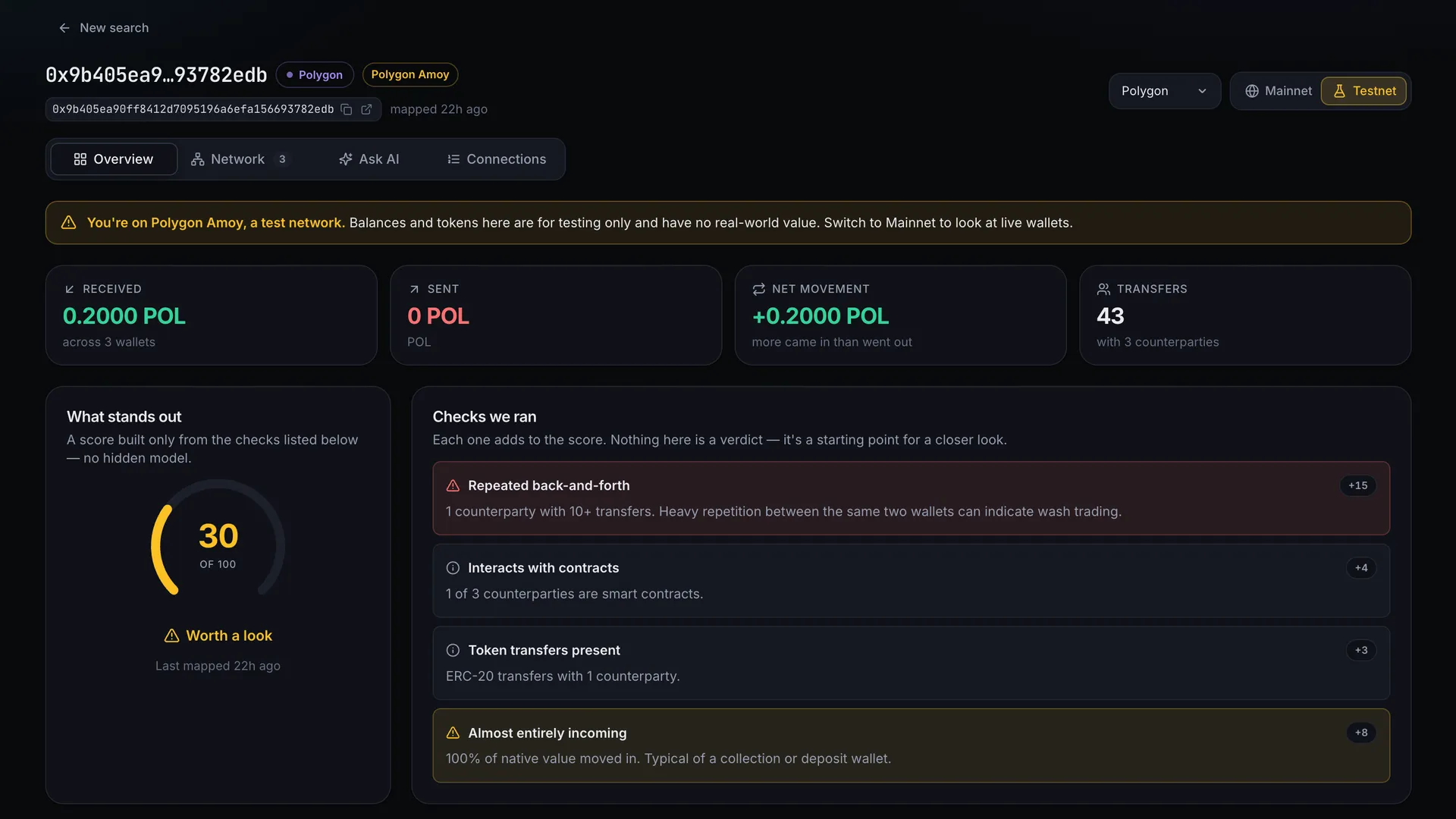
A live demo we built to show what an AI explorer can do: type a question about a wallet, and it reads the chain and answers.
Open the live demo- Plain-English queries like 'show last 5 transactions'
- Wallet investigation from a pasted address
- Transaction analysis without decoding raw hashes
- Relationship mapping between addresses that keep interacting
- Ethereum, BSC and Polygon in one interface
Why this exists
Public blockchain data is open to everyone and readable by almost nobody. The standard explorers show every transaction a wallet has ever made as a wall of hex strings and timestamps, then leave you to work out which ones matter. Anyone who needs an answer ends up asking the one person on the team who can read it.
That gap shows up wherever on-chain activity touches a real decision — onboarding a customer, checking a suspicious payment, working out who a counterparty deals with. The question is nearly always simple in English. Turning it into something an explorer can answer is the part that eats the afternoon.
What you can try
Things worth doing in the demo
This is a showcase rather than a product, so the useful test is not whether you like it. It is whether the same idea, pointed at your data, would answer a question you currently queue up for somebody else.
Ask in plain English
Type something like 'show last 5 transactions' and it works out which records that means. There is no query syntax to learn first.
Investigate a wallet
Paste an address and read what it has been doing, rather than scrolling a table of hashes and decoding them yourself.
Analyse the transactions
Transaction analysis on a single address: what moved, when, and with whom, summarised instead of left as rows for you to total up.
Map the relationships
Relationship mapping shows which other addresses a wallet keeps dealing with, which is usually the question sitting behind the question.
Switch chains, not tools
Ethereum, BSC and Polygon in one interface, so an address that shows up on two of them does not need two browser tabs.
Find where it stops
Push past 'show last 5 transactions' until the natural-language layer struggles. Knowing the edge is more useful than a demo that never fails.
What an equivalent gives you
What this would be worth built for you
This one is a showcase, so the honest framing is not what it does for us. It is what the same thing, pointed at your business, would change.
- WHO CAN ASK
- Answers for people who cannot read a chain
- The natural-language layer is the point. Someone in support or compliance types 'show last 5 transactions' and gets an answer, instead of raising a ticket and waiting on an engineer.
- ONE VIEW
- Ethereum, BSC and Polygon in one place
- Your version covers the chains your business actually touches, so nobody keeps three explorer tabs open and reconciles them by eye. Which chains are included is a scoping decision, not a default.
- INVESTIGATION TRAIL
- Relationship mapping you can act on
- Seeing which addresses a wallet keeps dealing with turns a list of transactions into something a person can decide from. That shift is the thing this demo exists to show.
- WHAT YOU OWN
- The build, on your infrastructure
- Source, deployment pipeline and the model choice handed over, so it becomes an internal tool your team can change rather than something you rent from us indefinitely.
How you'd get one
What building your version looks like
Typical durations for a first build of this shape. The first step is the one that decides whether the rest is worth doing at all.
Scoping
1 weekWe pick the one question this has to answer, name the chains involved, and work out who will actually be typing into it.
Prototype on your data
2–3 weeksA working version pointed at real addresses from your business. This is where you find out whether plain-English querying holds up against your actual questions.
Build
6–10 weeksThe chain data layer, the query interface, and the checks that stop a confidently wrong answer reaching a decision unchallenged.
Run and tune
OngoingReading the questions people actually ask, which is never the list from scoping, and tightening the paths they hit most.
Is this the kind of thing you need?
Worth reading before you get in touch — it saves both of us a call.
A good fit if…
- Your team already reads chain data and it is slow going
- Non-technical people need to ask questions about on-chain activity
- Your customers or counterparties hold wallets on Ethereum, BSC or Polygon
- You can name the one question this should answer first
Probably not, if…
- You need contracts audited, not read — see Smart Contract Development & Audit
- The records you want to question sit off-chain — see Data Engineering & Analytics
- You want a token or network platform built — see Custom Blockchain Solutions
- You need a certified regulatory filing tool, which this is not
Frequently Asked
Questions
Common questions about cost, running it, data handling and building a version of your own.
There is no list price, because the cost sits in things we have to look at first: how many chains, whether the data comes from a hosted provider or a node you run, and how much the answers have to be trusted. A read-only internal tool for one team is a different project from something customer-facing with an audit trail behind it. We scope before quoting, and scoping is usually where a too-expensive idea gets smaller rather than cancelled.
Two ongoing costs, and they behave differently. Chain data has to come from somewhere — either a hosted node provider billed per request, or infrastructure you run yourself. Then the language model that turns a question into a query, billed per use, which rises with how many people are asking rather than with your headcount. Both are predictable enough to model before you commit, and we would rather show you that number during scoping than after launch.
On-chain data is public already, so nothing is exposed by reading it. The sensitive part runs the other way: the addresses you choose to investigate say something about your business, and by default those queries pass through a commercial model provider. Where that matters, we run an open-source model on your own infrastructure instead, so the questions never leave your network. That is a decision to make during scoping, not something to retrofit once people are using it.
It will, occasionally. A language model can misread a question and answer a slightly different one with complete confidence, and on financial data that is the failure that matters. The defence is showing the underlying transactions alongside every answer, so a person can check the working instead of trusting a sentence. For anything that triggers a real action, such as freezing an account or flagging a customer, we build in a human confirmation step rather than assuming the answer is right.
That is the only way it gets built. The demo covers Ethereum, BSC and Polygon because those are common, not because the approach stops there. Your version would cover the chains your business touches, and the questions it handles well would be the ones your team asks most — which we find out by watching people work rather than by asking for a requirements list. The interface follows from that, not the other way round.
Have a project in mind?
Fixed price after a paid discovery — no hourly billing. A real engineer reads every enquiry, and we reply within 24 hours.