

Web3 Dapps
An app nobody is in charge of
A decentralised application on a blockchain, where the rules live in smart contracts anyone can read, transactions settle without a company in the middle, and you connect a wallet instead of creating an account.
Open the live demo- Smart contracts that execute the rules automatically
- Every transaction verifiable on a public chain
- Wallet sign-in instead of an email and password
- No admin account that can reverse a result
- The logic is published, not just described
The problem this exists to demonstrate
Most systems ask people to trust the company running them. When a payout is questioned, or a rule looks like it changed, the only answer available is a screenshot from someone's admin panel. To a customer, a partner or a member who is not an employee, that is not evidence — it is a promise.
A decentralised app answers the question differently. The rules sit in a smart contract on a public chain, so anyone can read what will happen before it happens, then check afterwards that it did. The trade is real: nobody can quietly correct a mistake either, and that constraint is half the point of the demo.
What you can try
What you can try in the demo
Everything here runs against a live chain. Nothing in it asks you to take our word for what just happened.
Connect a Web3 wallet
Sign in by connecting a wallet instead of creating an account. There is no password to reset and no signup form standing in the way.
Watch a smart contract run
Trigger an action and let the contract execute it automatically. No approval queue, no operator, and the same rules for whoever calls it next.
Read the logic before you use it
The on-chain logic is transparent, so you can see what the contract will do before you ask it to do anything at all.
Verify a transaction afterwards
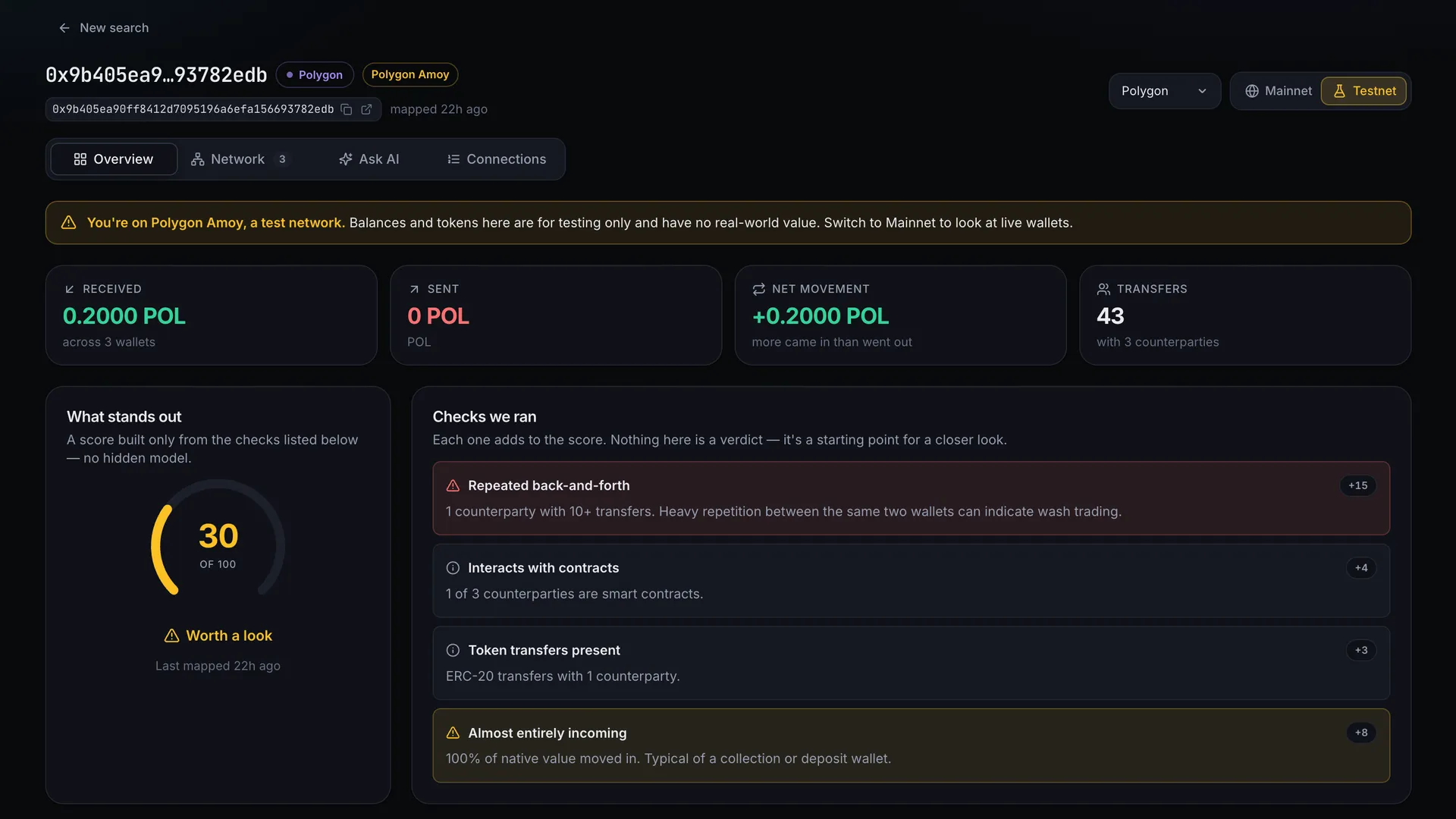
Every transaction lands on the public chain with a permanent record, so you can look it up independently rather than trusting a confirmation screen.
Look for the admin panel
There is no central authority behind this demo that can reverse a result, edit a balance or pause an account. That door does not exist.
Move value trustlessly
Send a transaction through the contract and watch it settle without an intermediary holding it in between. The conditions are met or nothing moves.
Check it on a block explorer
Take the contract address into any public explorer and see the same on-chain state the demo shows you, from a source we do not control.
Try something the rules forbid
Attempt an action the contract does not allow. It fails identically for everyone, because the condition is enforced in code rather than by a moderator.
Disconnect and come back
Disconnect the wallet and reconnect later. Your position is held on-chain rather than in a session on a server that could lose it.
What an equivalent gives you
What the same idea is worth in your business
This is a showcase, so the useful question is not what it does for us. It is what an equivalent would be worth pointed at a process of yours.
- AUDITABLE BY DEFAULT
- A record nobody can edit later
- Transactions are written to the chain permanently, so a partner or a member can verify an outcome themselves instead of asking your team for a screenshot from an admin panel.
- RULES IN CODE
- The policy executes itself
- The eligibility rule or release condition is written once into a smart contract, then applied identically to everyone who calls it, including the people who deployed it.
- NO OPERATOR TRUST
- Fewer disputes to arbitrate
- When the logic is transparent and the transactions are verifiable, most arguments about what happened end at a link. Your team stops being the referee in its own game.
- WALLET-NATIVE ACCESS
- Users who bring their own identity
- Web3 wallet integration means people arrive already holding their credentials. There is no password database on your side to secure, and nothing to breach if someone tries.
How you get one
What building your version looks like
Durations below are typical for a first on-chain build. The first step is the one that most often stops a project, and stopping there is much cheaper than stopping at audit.
Decide whether you need a chain at all
1 weekWe work out which part of your process genuinely needs someone outside your company to verify it. Often the honest answer is a database, and we say so.
Contract design
1–2 weeksThe rules get written down as conditions before any code: who may call what, what happens on failure, and what nobody is allowed to change later.
Build and audit
6–10 weeksContracts, the app around them and wallet integration, then testnet runs against real user flows and a third-party audit before anything holding value goes live.
Launch and run
OngoingMainnet deployment and monitoring, plus the unglamorous part: an on-chain mistake cannot be patched quietly, so upgrade paths are agreed before launch, not after.
Is this the right fit for you?
Worth reading before you get in touch — it saves both of us a call.
A good fit if…
- Several parties who do not fully trust each other share the same records
- Arguments about what the system actually did cost your team real time
- Your users already hold a Web3 wallet, or would get one
- The rule you want enforced can be written down precisely
Probably not, if…
- One company, one database, nobody external to convince — see Web & SaaS Platform Development
- The data must stay confidential — see Custom Blockchain Solutions for permissioned chains
- You already have contracts needing review — see Smart Contract Development & Audit
- You need to reverse transactions on request — see Custom Payment Gateway Integration
Frequently Asked
Questions
Common questions about cost, privacy and running a decentralised app.
Three things, mostly. How much of your logic genuinely has to live in the contract rather than in ordinary software, because on-chain code is slower to write and far more expensive to get wrong. Which chain you deploy to, since fees and tooling differ widely. And whether the contract will hold value, which makes a third-party audit non-negotiable rather than optional. A demo like this one is a fraction of a production build, and we scope properly before quoting anything.
Less day-to-day administration than a normal platform, because the contract executes the rules without anyone approving each action. What replaces it is monitoring: whether transactions are landing, and whether the front end still connects after wallet software updates. Chain fees need watching too. There is no server holding balances, so the failure modes move rather than disappear. Most teams keep a small ongoing arrangement with us for that instead of staffing it internally, at least in the first year.
No, and that is worth being blunt about. Anything written to a public chain is readable by anyone, permanently, including amounts and the addresses involved. Wallet addresses are pseudonymous rather than anonymous. So the real design work is deciding what needs to be on-chain and what stays in ordinary encrypted storage off it. If most of your data has to stay confidential, a permissioned chain or a conventional database is the better answer, and we would say so during scoping.
This is the genuine trade-off. A deployed contract cannot be quietly patched the way a web app can, so a bug that reaches mainnet is costly in a way ordinary bugs are not. That is why the process front-loads testnet runs and an external audit. It is also why upgrade paths, pause conditions and who may trigger them are decided before deployment rather than during an incident. Everything not in the contract stays in normal software, where it can be fixed normally.
This one is a showcase rather than a template you buy, and nothing here is sold as-is. The useful question is what an equivalent looks like for your process: which rule you want executing automatically, which record has to be verifiable by someone outside your company, and where a wallet makes more sense than a login. That conversation usually reshapes the idea before a line of contract code is written, and occasionally concludes that you do not need a chain.
Have a project in mind?
Fixed price after a paid discovery — no hourly billing. A real engineer reads every enquiry, and we reply within 24 hours.