


The fraud isn't in one transaction — it's in the connections between wallets
Looking at a single transaction is like reading one line of a phone bill. It tells you money moved. It doesn't tell you the pattern — who's really behind a…

Looking at a single transaction is like reading one line of a phone bill. It tells you money moved. It doesn’t tell you the pattern — who’s really behind a cluster of addresses, or where the funds quietly regroup two hops later. Relationship mapping draws those links so you can see the network, not just the entry point.
One transaction is a data point. A network is a story.
People who want to hide money don’t do it in one move. They split it, route it through intermediate addresses, and reassemble it somewhere that looks unrelated. If you’re checking each transaction in isolation, you’ll never see that — every entry looks clean on its own. The signal only appears when you map how addresses connect to each other. A balance tells you what’s there now; the relationships tell you how it got there and where it’s headed.
The part that makes it work (the short technical bit)
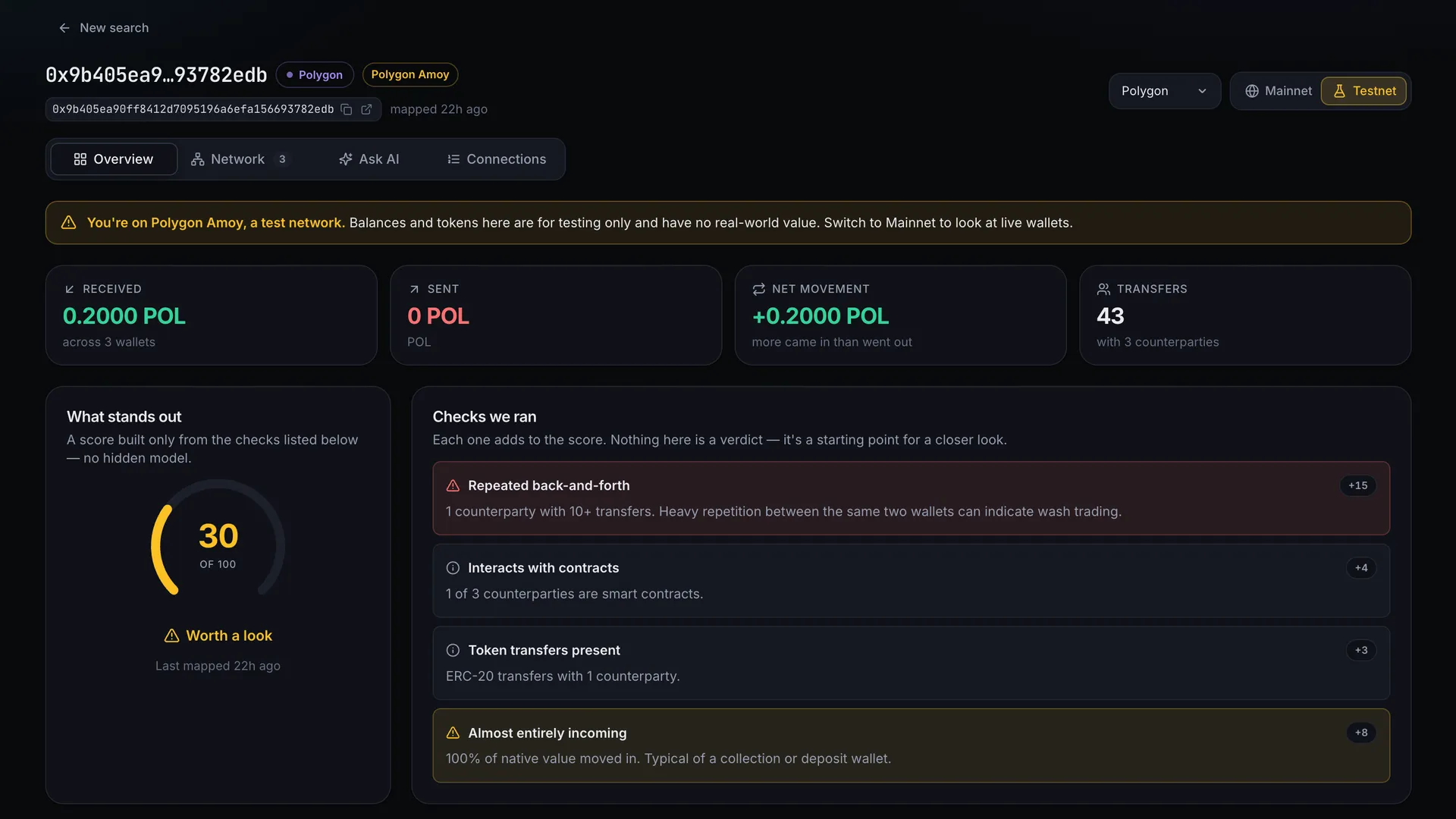
The explorer treats addresses and the transfers between them as a graph — nodes and edges. When you ask about a wallet, it doesn’t just list its transactions; it surfaces the other addresses it’s connected to and how. So instead of manually copying one address into a search, seeing where it sent funds, copying that address, searching again — for hours — you see the relationships laid out. The tedious part, the following, is what the tool does for you.
Where this earns its keep
Fraud investigation, obviously. But also due diligence: before you partner with someone whose treasury is on-chain, the connections around their wallet tell you more than the balance does. And internal risk — an exchange or fund watching for funds moving toward flagged addresses cares about the path, not just the final hop. In each case the question is the same: not “what’s in this wallet?” but “what is this wallet part of?”
FAQ
Can it show connections I’d miss by hand? That’s the point. Manually you can follow one or two hops before it gets unmanageable. Mapping the relationships surfaces the structure you can’t keep in your head.
Does this work across different blockchains? Yes — it spans Ethereum, BSC and Polygon, which matters because connected addresses rarely all sit on one chain.
Bottom line: if you’re investigating wallets one transaction at a time, you’re reading one line of the story. We built this map for a client — and we can build the same kind for you. See the explorer running.